
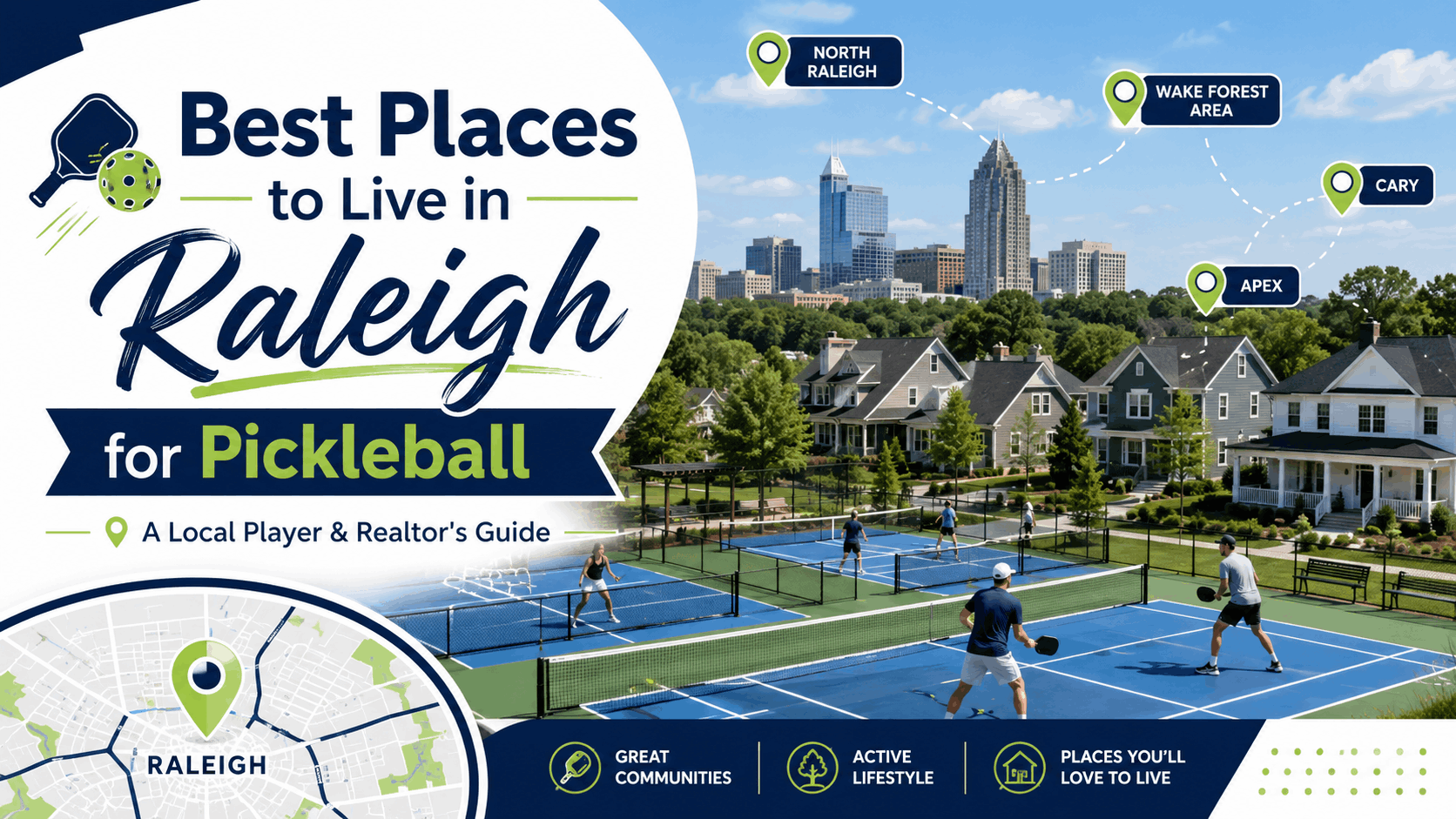
Best Places to Live in Raleigh for Pickleball: A Local Player & Realtor’s Guide
If you're moving to Raleigh and pickleball is a big part of your life, I think it deserves a place on your home-search checklist.
I'm not talking about choosing a house simply because an HOA advertises a pickleball court. If you play several times a week, the better question is: How easy will it actually be to get from your house to a good game?
I'm Conner Franck, a Raleigh Realtor and 3.5+ DUPR pickleball player. I've been playing for about a year and a half, usually three to five times a week, and I'm pretty addicted at this point.
My regular rotation includes Method Community Park, North Hills Park and Pin Point Raleigh. From where I live, I'm roughly 8 minutes from Method, 13 minutes from North Hills and 15 minutes from Pin Point. Having multiple places to play—two outdoor options plus a major indoor facility—has made me appreciate how much location matters once pickleball becomes part of your normal week.
That's why I created my Raleigh Pickleball Real Estate Guide and this article. If you're relocating to Raleigh, Cary, Apex, Wake Forest or another part of the Triangle, I want to help you understand not just where the courts are, but which areas make the most sense to live in if you actually plan to use them.
What Makes an Area Good for a Pickleball Player?
Raleigh has a lot of pickleball. The City of Raleigh currently lists 44 outdoor courts across 11 locations, plus scheduled indoor play at multiple community centers. Once you add private facilities, clubs and the municipal systems in Cary, Apex, Wake Forest, Fuquay-Varina and other nearby towns, there are a lot of options.
But I would not rank a neighborhood based only on the number of courts nearby.
If I were moving here specifically as a frequent player, I would look for a combination of:
- Multiple realistic places to play within about 10–15 minutes
- At least one dependable outdoor option
- Indoor access for winter, rain and extreme summer heat
- Open play or an established player community
- Courts that fit the level and type of play you enjoy
- A reasonable drive at the times you normally play
- A neighborhood and house that still make sense for the rest of your life
That last point matters.
Pickleball may help narrow your search, but I don't think you should overpay for a house just because there are courts nearby. Commute, housing type, location, amenities, resale appeal and your normal day-to-day routine still matter.
The best setup is usually a good home in a good location with more than one way to play nearby.
Quick Comparison: Raleigh-Area Places Pickleball Players Should Consider
| Area | Pickleball Access | Housing Snapshot | Best Fit |
|---|---|---|---|
| North Hills / Midtown | Excellent | Condos, townhomes and single-family homes through luxury | Best all-around Raleigh option |
| Method / University Park | Very good | Mostly higher-priced central Raleigh housing | ITB and central Raleigh buyers |
| South Raleigh / Caraleigh | Excellent | Broad range of condos, townhomes and houses | Indoor + outdoor access and value |
| North / Northwest Raleigh | Excellent | Established single-family neighborhoods and townhomes | Multiple public options |
| West Cary | Excellent | Suburban homes, townhomes and newer communities | RTP access + public court network |
| Apex | Excellent | Established neighborhoods and newer suburban communities | Free municipal pickleball |
| Wake Forest | Excellent | Townhomes through larger suburban homes | Strong pickleball community |
| Fuquay-Varina | Very good | Broad suburban inventory | Court access relative to housing cost |
| Brier Creek | Good today, potentially stronger | Condos, townhomes and single-family homes | RTP and RDU commuters |
These are intentionally broad categories. Drive times and housing inventory can change dramatically from one side of a neighborhood to another, so once you're looking at an actual home, I recommend checking the route to the courts at the time of day you normally play.
1. North Hills and Midtown Raleigh: My Best All-Around Raleigh Pick
If someone told me they wanted to stay in Raleigh proper, wanted strong pickleball access, and also wanted a location with plenty going on outside of pickleball, North Hills and Midtown would be one of the first places I'd look.
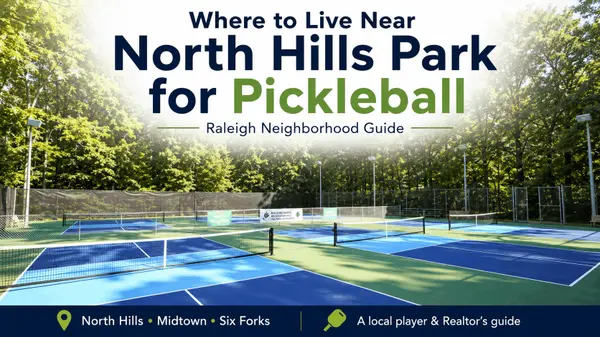
North Hills Park has six dedicated public outdoor pickleball courts with permanent nets and lights. There are also additional recreation and private-club options throughout North Raleigh, including North Hills Club nearby.
The bigger advantage, though, is that you're not choosing North Hills solely because of pickleball.
Midtown gives you convenient access to shopping, restaurants, parks, major roads and a wide range of housing. Depending on the specific location, buyers can find condos, townhomes, older single-family homes, renovated properties and much higher-end homes.
That makes pickleball an added lifestyle benefit rather than the neighborhood's only selling point.
What It's Like Playing at North Hills Park
North Hills is one of the places I personally play.
In my experience, it has an established group of regular players and can get very busy in the evening. I really notice the crowd increasing around 6 PM, so if my schedule allows it, I prefer getting there closer to 4 PM.
The courts are outdoors and lighted, so evening play is possible well after sunset.
North Hills is also a great example of something homebuyers should understand: six busy courts with an active player base can be more useful than living next to a larger group of courts where there isn't consistent open play.
If North Hills would be one of your main places to play, I'd look not only at North Hills itself but also parts of Midtown, Six Forks, Quail Hollow and nearby North Raleigh depending on your budget and housing preferences.
2. Method, University Park and West Raleigh: Best for Central Raleigh and ITB Living
If you want central Raleigh or prefer living Inside the Beltline, the area surrounding Method Community Park deserves serious consideration.
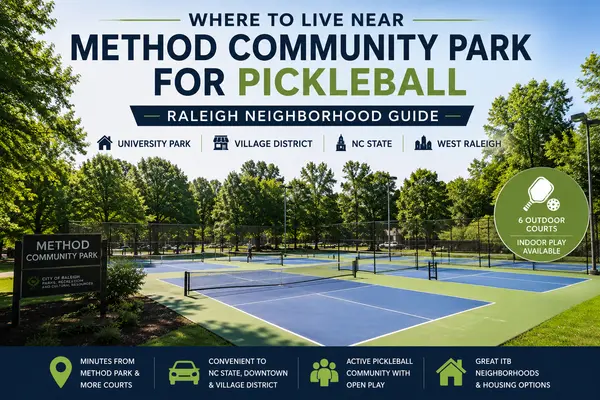
Method has six dedicated outdoor pickleball courts, along with indoor community-center play. Nearby facilities such as Jaycee Park and Fred Fletcher Park add additional options in the broader West Raleigh area.
From a real-estate perspective, this location is interesting because you're close to NC State, Village District, University Park and established ITB neighborhoods while still having a strong public pickleball facility nearby.
Housing here tends to be more expensive than many outer Raleigh neighborhoods, particularly in University Park and the most desirable ITB locations, but the tradeoff is central access.
What It's Like Playing at Method
Method is probably the court I'm closest to and another place I play regularly.
When NC State is in session, you tend to see a stronger student presence, and that gives Method a different feel from North Hills. The courts are outdoor, lighted and useful for evening games.
That difference between Method and North Hills is exactly why I like having both nearby. The courts aren't interchangeable just because they have the same number of nets.
For someone who wants to live around NC State, Village District, University Park or West Raleigh and also plays frequently, Method is a very strong anchor.
3. South Raleigh and Caraleigh: Best Combination of Indoor and Outdoor Pickleball
South Raleigh may be the area I think relocating pickleball players are most likely to underestimate.
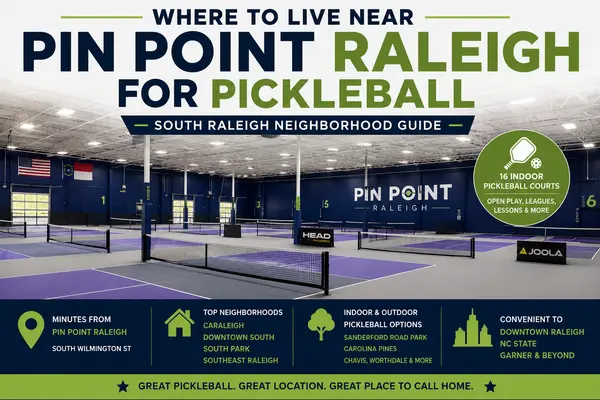
The headline facility is Pin Point Raleigh, which has 16 dedicated indoor courts. Nearby, Sanderford Road Park adds 10 dedicated outdoor courts, and additional Raleigh Parks facilities create more backup options across South and Southeast Raleigh.
That combination is hard to ignore.
You're not choosing between paying for indoor play or relying entirely on the weather. You can have both within the same broader part of the city.
From a housing perspective, South Raleigh also offers a broad mix of properties. Depending on the exact location, buyers can find townhomes, newer construction, older single-family homes and properties relatively close to downtown.
For a buyer who wants pickleball access but doesn't necessarily want North Raleigh or Cary pricing, I would absolutely include this area in the conversation.
What It's Like Playing at Pin Point Raleigh
Pin Point is usually my winter option.
I especially like the $5 Friday open play. One thing worth knowing is that it can fill surprisingly fast—even though Pin Point has a lot of courts.
That's the kind of detail that matters if you're deciding that a certain facility will be your primary place to play.
Indoor access is fantastic, but popular programming can still be popular.
If I were looking for a home around South Raleigh specifically because I wanted access to Pin Point, I would also consider how easy it is to reach Sanderford and other public courts. That gives you another option when the indoor schedule doesn't line up with yours.
4. North and Northwest Raleigh: Best for Having Multiple Backup Options
North and Northwest Raleigh don't depend on one giant pickleball destination. Their strength is redundancy.
Depending on where you live, facilities such as Lake Lynn Community Center, Baileywick Park, Laurel Hills Community Center, Optimist Community Center and North Hills Park can all come into play.
For someone who plays several days a week, I like that.
If one facility is packed, has a schedule conflict or isn't ideal that day, you may have another option nearby.
This part of Raleigh also contains a lot of established residential neighborhoods, particularly around Leesville, Lake Lynn, Stonehenge, North Raleigh and the 27613/27615 area.
If you're looking for an established single-family home and want to stay inside Raleigh while maintaining several public playing options, North and Northwest Raleigh should be high on your list.
5. West Cary: Best Suburban Public Pickleball Network
If you're willing to live outside Raleigh city limits, West Cary may have one of the strongest overall public pickleball ecosystems in the Triangle.
Facilities such as McCrimmon Park, Carpenter Park, Ed Yerha Park and Cary Tennis Park put a substantial number of outdoor courts in the same general part of Cary. There are indoor options as well.
What makes Cary particularly interesting is that the town offers more than just courts. There are organized programs, leagues, ladders, instruction and events.
For someone relocating who doesn't already have a group of people to play with, that structure can make getting established much easier.
West Cary also makes a lot of sense for people working in RTP, Morrisville or near the airport.
Housing tends to have a more suburban feel than central Raleigh, with townhomes, established subdivisions and newer communities. Areas such as Carpenter, Cary Park and Amberly are especially worth understanding if pickleball and RTP access are both priorities.
6. Apex: Best for Players Who Want Lots of Public Outdoor Courts
Apex is another area that surprised me when looking at the total public pickleball inventory.
The town's system includes roughly 21 outdoor court setups across facilities such as Pleasant Park, Apex Community Park, Kelly Road Park, the Apex Elementary joint-use courts and Seymour Athletic Fields, with additional indoor play at John M. Brown Community Center.
For a player who prefers free municipal courts rather than joining a private club, that's compelling.
Pleasant Park is especially notable because it has six dedicated outdoor courts in one location. Having multiple courts together generally makes it easier to have several games going and find players around your level than having one or two isolated neighborhood courts.
Apex also gives buyers a mix of established neighborhoods, newer subdivisions and access to its downtown core.
If you work in western Wake County or don't mind being farther from Downtown Raleigh, Apex belongs on the shortlist.
7. Wake Forest: Best for Finding a Pickleball Community
Wake Forest stands out for a slightly different reason.
It has plenty of actual court access, including municipal facilities and Pickles & Play, but the bigger story is the organized pickleball community.
Wake Forest's municipal system includes a significant number of court setups, and the Wake Forest Pickleball Club works with the town on clinics, leagues and other programming.
That's important for someone relocating.
If you're moving to Raleigh from another state, you may not already have seven people saved in your phone who can play tomorrow night. Being near courts is helpful; being near an established group of players can be even better.
Wake Forest offers housing from townhomes to larger suburban homes, and areas such as Heritage, Downtown Wake Forest and north Wake Forest can put you near different parts of the local pickleball network.
If the social side of the sport matters to you as much as the courts themselves, Wake Forest deserves a close look.
8. Fuquay-Varina: A Sleeper Pick for Court Access
Fuquay-Varina doesn't get as much attention in Raleigh pickleball conversations, but it has an impressive municipal setup.
South Park Community Center has five indoor courts, while Hilltop Needmore Community Center has nine. There are outdoor options as well.
That gives Fuquay an unusual amount of public indoor capacity for a suburban market.
The tradeoff is location.
If you commute regularly to Downtown Raleigh, RTP or North Raleigh, I'd compare that drive carefully before allowing pickleball to push you farther south than you otherwise want to live.
But for someone who works remotely, works in southern Wake County or simply prefers the Fuquay area, the combination of housing options and court access is worth knowing about.
9. Brier Creek: Best for RTP and RDU Access With Pickleball Upside
Brier Creek is a little different because part of its pickleball story is still being built.
There is municipal indoor pickleball available in the area today, and Morrisville facilities are nearby. There are also major private racquet developments in the pipeline around Brier Creek.
As of August 2026, Pickles & Play's Brier Creek location is still under construction, while the larger Swing Racquet + Paddle project has had its anticipated timeline pushed out.
That means I would not buy a house in Brier Creek based on a promised future pickleball facility.
Buy because the location, house, commute and amenities make sense today. If the new facilities open as planned, consider that upside.
For someone working in RTP or traveling frequently through RDU, Brier Creek can already be a very practical real-estate choice. Future pickleball development could make it even more interesting.
Which Raleigh Area Would I Choose If Pickleball Were a Major Priority?
If I were moving to Raleigh and expected to play three to five times a week—as I do now—I would not make my decision based on which neighborhood has the biggest court complex.
I would rather have two or three genuinely usable options within 10–15 minutes.
My current setup is a good example:
- Method Community Park is about 8 minutes away
- North Hills Park is about 13 minutes away
- Pin Point is about 15 minutes away
That gives me two major outdoor options and a large indoor facility.
It also gives me different types of play.
If Method is crowded, I can go somewhere else. If it's raining or cold, I have Pin Point. If I want North Hills open play but know I'm going later in the evening when it gets busier, I can adjust.
For me, that's much more valuable than living in an HOA that happens to have two pickleball courts.
Of course, your answer might be completely different.
Someone working in RTP may be better served by West Cary or Brier Creek. Someone who wants a central ITB lifestyle may prefer Method and University Park. Someone looking for an established social pickleball scene may love Wake Forest.
That's why I think pickleball should be one part of the home-search equation—not the entire equation.
Public Courts vs. HOA Courts: Don't Assume HOA Is Better
This is one of the biggest things I would caution buyers about.
A listing might advertise "community pickleball courts," and that sounds great.
But before treating those courts as a major reason to buy, find out:
- How many pickleball courts are actually there?
- Are they dedicated courts or tennis courts with pickleball lines?
- Are permanent nets provided?
- Are the courts lighted?
- Can guests play?
- Can residents reserve them?
- Is there organized open play?
- Are there actually enough players in the community to get games?
- Are there rules limiting hours?
- What do the HOA documents say about the amenity?
A busy public facility with six courts and a strong player base could be substantially more useful to you than two beautiful HOA courts that are usually empty.
And from a real-estate perspective, I would rather see a home maintain its appeal for multiple reasons—location, housing quality, access to employment, parks, restaurants and transportation—than rely heavily on one recreational amenity.
How I Would Search for a Raleigh Home as a Pickleball Player
If you're relocating here, I would start with the normal real-estate criteria and then layer pickleball on top.
A useful starting checklist would be:
-
Home budget
-
Preferred house type
-
Work location and normal commute
-
Raleigh vs. surrounding suburbs
-
How many days per week you play
-
Indoor vs. outdoor preference
-
Public open play vs. private club
-
Recreational vs. more competitive play
-
How far you're realistically willing to drive to play
-
Whether neighborhood/HOA courts matter to you
-
Exact drive time from houses you like to your preferred facilities
Once those pieces are clear, we can make the home search much more specific.
For example, if you tell me:
"I work in RTP, have a $600,000 budget, want a single-family home and play around 3.5–4.0 four nights a week,"
that's useful information.
It tells me that we shouldn't just search "Raleigh."
We should compare areas such as West Cary, Apex, Brier Creek, North Raleigh and potentially other parts of Wake County based on both your real-estate priorities and your ability to get on a court after work.
You can search Raleigh-area homes here, but if pickleball is a meaningful part of the decision, I'd rather help you build a search around the way you actually live.
My Pickleball + Real Estate Takeaways
If you're trying to narrow down the Raleigh area, these are my starting points:
North Hills / Midtown: My strongest all-around Raleigh recommendation.
Method / University Park: Excellent if you want central Raleigh or ITB living.
South Raleigh: One of the most underrated combinations of indoor and outdoor pickleball.
North / Northwest Raleigh: Great for buyers who value having several backup facilities.
West Cary: Probably the strongest suburban public-court network.
Apex: Excellent if free municipal outdoor play is a priority.
Wake Forest: One of the strongest choices for players who want a built-in pickleball community.
Fuquay-Varina: A sleeper option with a surprising amount of public indoor play.
Brier Creek: Very practical for RTP/RDU buyers, with additional pickleball development potentially coming.
There isn't one neighborhood that is objectively "best" for every pickleball player.
The right answer depends on where you work, what you want to spend, what kind of house you want and how you like to play.
Raleigh Pickleball Real Estate FAQ
What is the best area of Raleigh to live in for pickleball?
For Raleigh proper, I would start with North Hills/Midtown, West Raleigh near Method, South Raleigh and North/Northwest Raleigh.
North Hills is my strongest all-around choice because it combines an established public pickleball hub with access to additional North Raleigh facilities and a location that remains desirable for plenty of reasons outside pickleball.
The best choice for you may be different depending on your work location, budget and preferred style of play.
Is Raleigh or Cary better for pickleball?
Both are very good.
Raleigh has a large municipal network spread across the city, plus commercial and private options such as Pin Point and North Hills Club.
Cary stands out for its concentrated public-court network and organized municipal programming.
If you work in RTP and prefer suburban housing, Cary may make a lot of sense. If you want central-city access or an ITB lifestyle, Raleigh will probably fit better.
Where can I live near indoor pickleball in Raleigh?
South Raleigh is one of the strongest places to consider because of Pin Point's 16 dedicated indoor courts and the surrounding public outdoor options.
North Raleigh, Cary, Wake Forest and Fuquay-Varina also have indoor pickleball opportunities through community centers or private facilities.
I would check the actual schedule and access rules before choosing a home based on a specific indoor program.
Is North Hills good for pickleball players?
Yes.
North Hills Park has six dedicated outdoor courts and is an established open-play location. North Hills Club provides another private option nearby, and additional North Raleigh facilities are within a relatively short drive.
In my own experience, North Hills can become quite busy in the evenings, particularly around and after 6 PM.
Is Method Community Park a good place to play pickleball?
Yes. Method is one of my regular courts.
It has six dedicated outdoor courts, lights for evening play and additional indoor pickleball programming at the community center.
Its location near NC State, University Park and Village District also makes it particularly interesting for buyers who want to live in central or West Raleigh.
Is Wake Forest good for pickleball?
Yes. Wake Forest is one of the strongest Raleigh-area options if the community side of pickleball matters to you.
There are municipal facilities, commercial indoor play at Pickles & Play and organized programming through the local pickleball community.
For someone relocating without an established group of players, that can be a big advantage.
Should I buy in a Raleigh neighborhood with HOA pickleball courts?
Not necessarily.
HOA courts can be a great amenity, but I would verify the number of courts, whether they're dedicated, reservation rules, guest rules, lighting and whether there is an active group of players.
I would also look at what other public or private facilities are nearby. Having multiple independent options gives you much more flexibility.
Can you help me find a house based on pickleball access?
Absolutely.
That's one of the reasons I created my Raleigh Pickleball Real Estate Guide.
Tell me where you'll work, what you want to spend, what type of home you're looking for and how often you play. I can help narrow the Raleigh area based on both the normal real-estate considerations and access to the type of pickleball you actually want to play.
Moving to Raleigh and Love Pickleball? Let's Find the Right Area
If pickleball is already part of your weekly routine, tell me about it when we start your home search.
I play three to five times a week myself, so you won't have to explain why living 10 minutes from a good open-play facility is different from living 30 minutes away—or why an indoor backup can matter in January.
I'll help you compare Raleigh, Cary, Apex, Wake Forest and the surrounding communities based on the whole picture: the house, location, commute, lifestyle and, yes, how easily you can get on a pickleball court.
You can browse Raleigh-area homes for sale, explore my Raleigh Pickleball Real Estate Guide, or contact me directly.
Conner Franck
Raleigh, NC Realtor
conner@lakeplease.com
(434) 774-6593
Categories
Recent Posts