
How Deep Does the Water Need to Be for Your Boat on Lake Gaston?
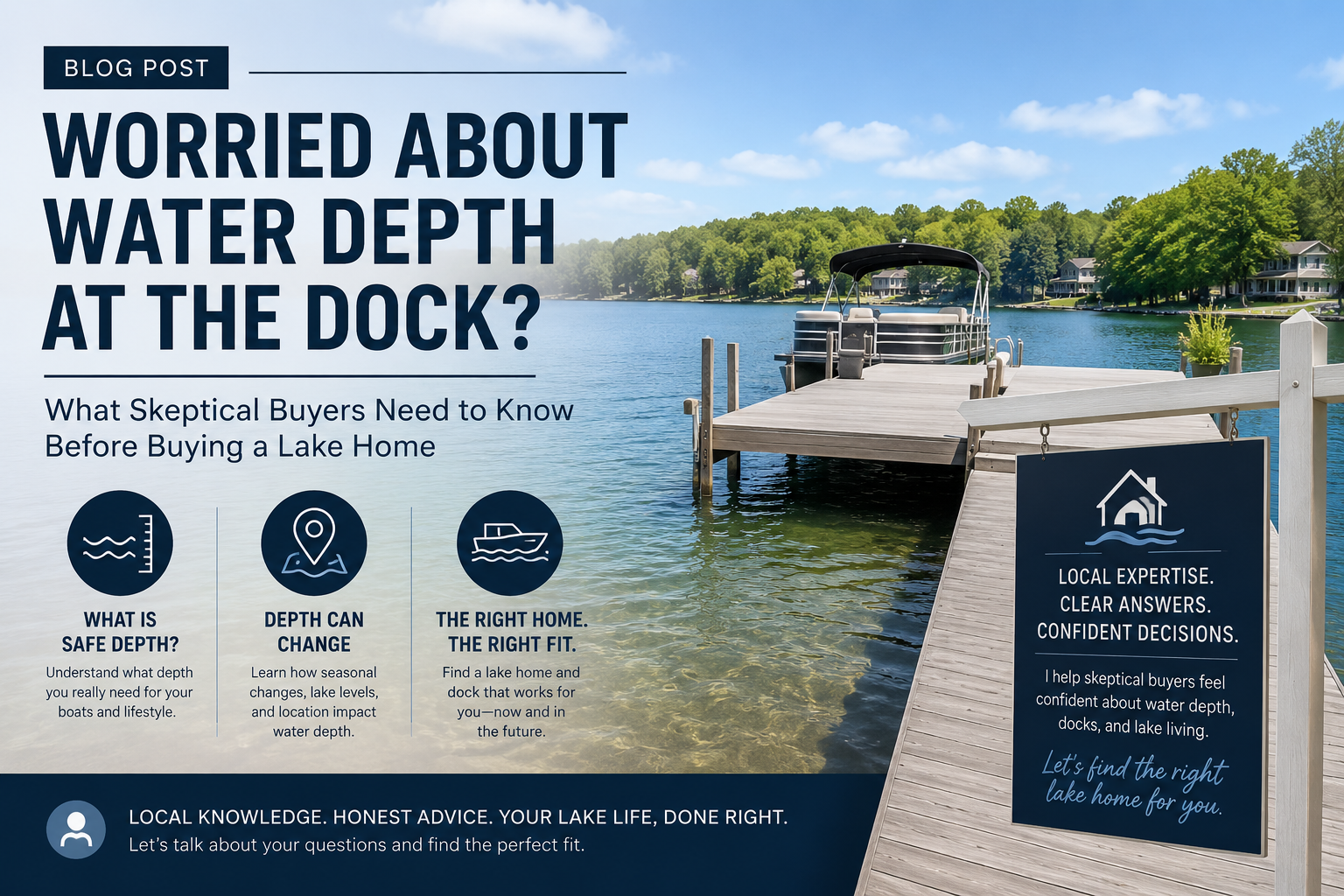
One of the biggest concerns Lake Gaston waterfront buyers have is water depth.
A buyer may walk down to a dock, look at the cove, and immediately wonder: “Is this deep enough for my boat?”
That is a smart question, but it is not always as simple as it seems. The depth at the dock matters, but it is only one part of the full picture. What often matters more is whether your boat can safely get from the dock, through the cove, and out to deeper navigable water or the main channel.
In other words, you do not necessarily need every inch of water around the dock to be deep. You need enough usable water for your specific boat and a safe path to where you actually want to boat.
That distinction is important because some buyers may overlook a good Lake Gaston property simply because they are unsure how to evaluate water depth. On the other hand, buyers should also be careful not to assume every waterfront home will work for every boat.
If you are shopping for waterfront property, this is exactly the type of issue where working with a local Lake Gaston agent can make a big difference. You can browse Lake Gaston homes for sale, but before making an offer on a waterfront home, you need to understand how the property actually works from the water.
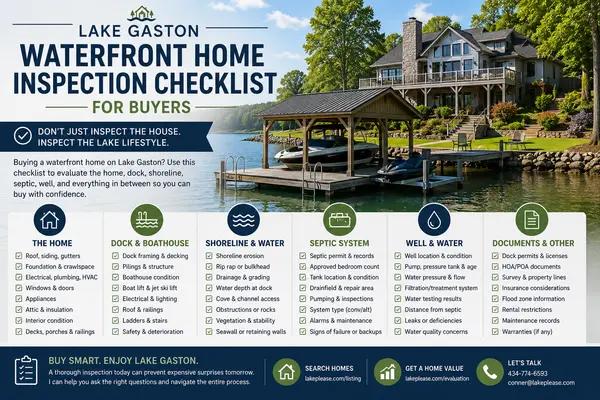
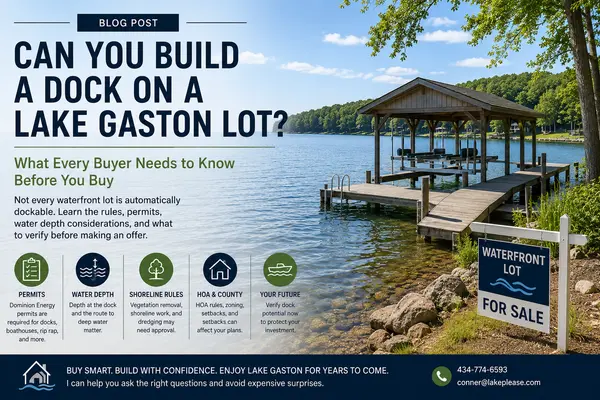
You may also want to read my guides on waterfront vs. off-water homes on Lake Gaston, Lake Gaston dock permits, and Lake Gaston boating rules.
Why Water Depth Matters to Lake Gaston Buyers
Water depth affects how usable a waterfront property feels.
For many buyers, the whole point of buying on Lake Gaston is being able to keep a boat at the property, use the dock, swim, fish, paddleboard, or take family and friends out on the water. If the water is too shallow for the way you want to use the property, the home may not fit your lifestyle.
Water depth can affect:
- Boat access
- Dock usability
- Boat lift setup
- Swimming
- Kayaks and paddleboards
- Jet skis
- Fishing
- Resale value
- Rental appeal
- Buyer confidence
But buyers should not panic just because the water near the shoreline looks shallow. Waterfront lots often slope gradually into the lake, and many docks extend out to more usable water. The key is evaluating the actual dock area, the path out of the cove, and your specific boat.
Boat Draft Explained Simply
Boat draft is the amount of water a boat needs underneath it to float safely.
A small kayak or paddleboard needs very little water. A jet ski generally needs less water than many larger boats. A pontoon boat may need moderate depth. A wake boat, larger bowrider, cabin cruiser, or sailboat may need more.
The exact draft depends on the boat’s design, weight, motor, fuel, passengers, gear, trim, and how it is being operated.
This is why buyers should not rely on a generic answer like “three feet is enough” or “five feet is enough.” The real answer is:
How much water does your specific boat need, and can you safely get from the dock to the main boating area?
If you already own a boat, check the manufacturer’s specifications and talk with your marina or boat dealer. If you do not own a boat yet, think about what type of boat you are likely to buy before choosing a waterfront home.
Typical Lake Boats and Water Depth Concerns
Different boats create different concerns.
Pontoon boats
Pontoon boats are popular on Lake Gaston because they are comfortable, family-friendly, and great for cruising. They generally do not require as much depth as some larger or heavier boats, but they still need enough water around the dock and lift to avoid bottom contact.
A pontoon buyer should look at dock depth, lift setup, cove access, and whether the boat can safely leave the dock without dragging or stirring up the bottom.
Wake boats and surf boats
Wake boats can be heavier and may require more usable water, especially when loaded with passengers, gear, ballast, and fuel. Buyers with wake boats should be more careful about shallow coves, tight access, and areas where water depth changes quickly.
Wake boats also create larger wakes, so buyers should think about whether the cove is appropriate for that type of use and whether the home is close enough to open water.
Bowriders and runabouts
Bowriders and runabouts are common lake boats. They can work well for cruising, tubing, and general recreation, but the needed depth depends on size and engine configuration.
Buyers should look at the depth at the dock, the route out, and whether the boat can be lifted, tied up, or launched conveniently.
Fishing boats
Many fishing boats can handle less water than larger recreational boats, but shallow water can still be an issue around docks, stumps, rocks, or tight coves. If fishing is your main priority, access to the parts of the lake you want to fish may matter more than having deep water directly along the shoreline.
Jet skis
Jet skis are flexible and do not need the same setup as a large boat, but they still require safe dock access, lift space, and responsible operation around docks, swimmers, and other boats.
Sailboats and larger boats
Sailboats, cabin cruisers, and larger boats can require more depth and more careful evaluation. If you own a larger boat, do not assume every waterfront property will work. You need to evaluate depth, cove access, bridge clearance, dock configuration, and maneuvering space.
The Dock Is Only One Part of the Question
Many buyers focus only on the water depth directly at the dock. That is important, but it is not the only question.
You should also ask:
- How deep is the water at the end of the dock?
- How deep is the water under the boat lift?
- Does the depth change quickly?
- Is the cove navigable?
- Are there shallow spots between the dock and the main channel?
- Are there stumps, rocks, or obstructions?
- Can you turn the boat around safely?
- Is there enough room to approach the lift?
- Does the water get deeper as you leave the dock?
- Can you reach the main boating channel without issue?
A property may have shallow shoreline but still be very usable if the dock extends to adequate depth and the cove has a safe path out.
The bigger concern is when the dock area and the route out are both limited for the type of boat you want to use.
Getting to the Channel Is Often the Bigger Issue
For many skeptical buyers, this is the key point:
You do not need the entire cove to feel like the middle of the lake. You need enough usable water to safely get your boat from the dock to deeper water or the main channel.
Once you are out of a shallow dock area or protected cove, boating can become much easier. That is why a local review matters. A property that looks questionable at first glance may still work well if the route out is practical for your boat.
On the other hand, a property with a beautiful view may still be frustrating if the path out is too shallow, narrow, or difficult for the boat you plan to use.
When I help buyers evaluate waterfront homes, I want to understand not just what the dock looks like from the yard, but how the property actually functions from the water.
Main Lake vs. Cove Water Depth
Lake Gaston homes can feel very different depending on whether they are on the main lake, a wide cove, a narrow cove, or a creek area.
Main-lake properties
Main-lake properties may have stronger open-water views and better immediate boating access, but they may also experience more boat traffic, wake exposure, and shoreline wear.
Cove properties
Cove properties can offer more privacy, calmer water, and a quieter feel. Some coves are deep and easy to navigate. Others may be shallower or more limited depending on location.
Creek areas
Areas around creeks and coves can vary widely. Some offer excellent boating access. Others require more careful navigation.
This is why buyers should not rely only on the address, town, or listing photos. You need to evaluate the actual water.
If you are comparing areas, read my guide to the best areas to buy a lake house on Lake Gaston.
Why Water Depth Affects Value
Water depth can affect value because it affects usability.
A waterfront home with deep, usable water may attract a broader pool of buyers. A property with limited depth may still sell well, but it may appeal to a narrower group depending on the price, location, view, dock setup, and buyer expectations.
Water depth can influence:
- Buyer confidence
- Dock value
- Boating convenience
- Vacation-home appeal
- Rental appeal
- Resale value
- Negotiation strength
- Time on market
This does not mean shallow-water properties are bad. Some buyers care more about views, price, privacy, kayaking, paddleboarding, fishing, or quiet water than large-boat access.
The key is matching the property to the buyer’s intended use.
What Buyers Should Ask Before Making an Offer
Before making an offer on a Lake Gaston waterfront home, ask:
- What type of boat do I own or plan to buy?
- What is the boat’s draft?
- How deep is the water at the dock?
- How deep is the water at the lift?
- Is the cove navigable?
- Is there a clear path to deeper water?
- Are there known shallow spots?
- Are there rocks, stumps, or obstructions?
- Can the dock or lift be modified?
- Is the dock permitted?
- Is the boathouse permitted?
- Is dredging allowed or realistic?
- How does the water compare to nearby homes?
- Would future buyers have the same concern?
That last question matters. Even if the property works for you, future resale should still be considered.
What Sellers Should Know About Water Depth
If you are selling a Lake Gaston waterfront home, buyers may ask about water depth. Be prepared.
A seller who can clearly explain water access may help buyers feel more confident.
Helpful information may include:
- Approximate water depth at the dock
- Type of boats currently used there
- Dock and lift setup
- Photos from the water
- Any known shallow areas
- Boathouse or dock documentation
- Dredging history, if any
- Shoreline improvements
- Notes about cove access
- Whether the current owner keeps a boat there
Sellers should not exaggerate or guess. But clear, accurate information can help reduce uncertainty and support the value of the property.
If you are thinking about selling, read my guide on how much your Lake Gaston home is worth.
Do You Need Deep Water If You Do Not Own a Boat?
Not necessarily.
Some buyers want waterfront for the view, swimming, kayaking, paddleboarding, fishing, or peaceful lake access. If you do not plan to own a larger boat, you may not need the same depth as a buyer with a wake boat or cabin cruiser.
However, even non-boating buyers should think about resale. Future buyers may care about boat access, so water depth can still affect marketability.
A property with beautiful views and modest water depth may be perfect for one buyer and wrong for another.
Should Shallow Water Be a Deal-Breaker?
Sometimes yes. Sometimes no.
Shallow water may be a deal-breaker if:
- You own a larger boat that needs more depth
- You cannot safely reach deeper water
- The dock or lift is not usable
- The cove is difficult to navigate
- Future dock improvements are limited
- Resale concerns are significant
Shallow water may not be a deal-breaker if:
- Your boat does not require much depth
- You mainly want views and quiet water
- The dock extends to usable depth
- You can safely reach the channel
- You use kayaks, paddleboards, or jet skis
- The price reflects the limitation
- The property has other strong features
This is why the answer depends on the property and your goals.
Why You Should Not Evaluate Water Depth Alone
Water depth is important, but it should be evaluated with the rest of the property.
A strong Lake Gaston waterfront purchase should also consider:
- Dock condition
- Boathouse condition
- Permits
- Shoreline stability
- View
- Lot slope
- Parking
- Home condition
- Septic capacity
- Internet
- HOA rules
- Rental potential
- Resale value
- Overall price
A property may have deep water but need major repairs. Another may have less depth but better views, lower maintenance, a stronger location, and a better price.
Your goal should be to understand the full tradeoff.
How a Local Agent Can Help
Water depth is one of those details that is hard to evaluate from a listing.
Online photos may show a beautiful dock, but they do not always show:
- How shallow the cove is
- How far the dock extends
- Whether boats can access the channel easily
- How the water changes around the shoreline
- Whether the dock is positioned well
- Whether the property fits your specific boat
- Whether the issue may affect resale
That is why buyers should not rely on photos alone.
If you are worried about whether a waterfront property will work for your boat, I can help you ask better questions, compare properties, review dock setup, and think through whether the water access fits your actual use.
Final Thoughts on Lake Gaston Water Depth and Boats
Water depth matters, but it should not automatically scare buyers away.
The real question is not simply, “How deep is it at the shoreline?” The better question is, “Can my boat safely use this dock and get from here to navigable water?”
For many buyers, the path from the dock to deeper water or the main channel is what matters most. Once you understand that, you can evaluate waterfront homes more confidently.
Some Lake Gaston properties will be perfect for larger boats. Others may be better for pontoons, fishing boats, jet skis, kayaks, paddleboards, or buyers who mainly want quiet water and lake views.
The right property depends on your boat, your lifestyle, your budget, and your long-term goals.
Frequently Asked Questions About Lake Gaston Water Depth and Boats
How deep does the water need to be for a boat on Lake Gaston?
It depends on the boat. Different boats have different drafts, and the needed depth can change based on weight, passengers, gear, and trim. Buyers should check their boat’s specifications and evaluate both dock depth and access to deeper water.
Does water depth at the dock matter?
Yes, but it is not the only thing that matters. Buyers should also consider whether the boat can safely leave the dock, navigate the cove, and reach deeper water or the main channel.
Is shallow water always bad for a Lake Gaston home?
No. Shallow water may still work for kayaks, paddleboards, jet skis, small fishing boats, or buyers who care more about views and quiet water. It becomes more concerning when it limits the intended boat use or future resale appeal.
What should I ask before buying a Lake Gaston home with a dock?
Ask about water depth, dock condition, boat lift setup, cove access, known shallow areas, obstructions, dock permits, shoreline condition, and whether the current owner keeps a boat there.
Is main-lake water better than cove water?
Not always. Main-lake properties may offer open views and easier boating access, while cove properties may offer calmer water and more privacy. The right choice depends on how you plan to use the property.
Can water depth affect resale value?
Yes. Water depth can affect buyer confidence, dock usability, rental appeal, and resale value, especially for buyers who want larger boats or easy access to deeper water.
Should I skip a home if the dock water looks shallow?
Not automatically. First determine whether the dock, lift, and route to deeper water work for your specific boat. A local review can help you decide whether it is a real issue or just something that needs context.
Thinking About Buying or Selling on Lake Gaston?
If you are buying a Lake Gaston waterfront home and are worried about water depth, I can help you compare properties based on dock setup, cove access, water usability, boat fit, and long-term resale value.
If you are selling a Lake Gaston home, I can also help you explain your dock, shoreline, and water access clearly so buyers understand the property’s value.
You can reach me directly at conner@lakeplease.com or call/text me at 434-774-6593.
You can also search Lake Gaston homes for sale, request a Lake Gaston home valuation, or contact me here.
Categories
Recent Posts